
Find the right surfboard for you.
- The right size and volume.
- The right shape for your waves.
- More waves. More fun.
8 quick questions. No email needed.
Underground Surf, 306 Hibiscus Coast Highway, Orewa Beach, Auckland Matching surfers to boards since 1997 4.9 ★★★★★ from 247 Google reviews.
Step 1 of 8
Your height and weight
Weight sets how much float you need. Height helps with length and stance. Age doesn't change it on its own.
Step 2 of 8
What can you do on a board right now?
Pick the last one you can do most sessions. Be honest, it gets you a better board.
Step 3 of 8
How often do you surf?
Over a normal few months, not your best summer.
Step 4 of 8
How does your body feel out there?
This isn't about skill. A strong surfer who's short on paddle fitness still catches more waves with a bit more float.
Can you paddle for 20 to 30 minutes, with breaks?
How do pop-ups feel? Think shoulders, back, hips and knees.
Step 5 of 8
How do you feel in the ocean?
Being fit and being at home in the surf are different things. This keeps our advice safe.
Can you swim confidently in open water, out of your depth?
Can you stay calm after a wipeout, or if you lose your board?
Step 6 of 8
What waves do you usually surf?
The waves you surf most weeks, not the dream trip.
Usual size, measured on the wave face
How do they break?
Step 7 of 8
What would make your next board a win?
Think about the next 6 to 12 months. Wanting to progress fast doesn't always mean a smaller board.
Step 8 of 8
Who do you usually surf with?
Surfing with the family usually means smaller, friendlier waves.
Quick volume check
Surfboard volume calculator
Volume to weight is a starting point, not a verdict. For a board matched to your waves and goals, use the full finder.
What can you do now?
Board guide
Surfboard size and volume guide
The short version: the right board isn't the smallest one you can stand on. It's the one that gets you the most good waves for the surfing you want to do.
What is surfboard volume?
Volume is how much space the board takes up, in litres. More litres means more float: you sit higher, paddle easier and catch waves earlier.
It doesn't tell you everything. Length, width, rocker, rails and where the foam sits all change how a board paddles and turns. Two 40 litre boards can feel nothing alike.
Use the maker's listed volume. Length x width x thickness gives you a box, not a surfboard, so that number is always far too high.
Volume to weight: the starting bands
Board litres divided by your weight in kg, times 100. A 35 litre board for an 85 kg surfer is 41%. These bands come from Surf Simply's coaching guide. They're a starting point, not a rule.
| What you're working on | Volume to weight | 85 kg surfer |
|---|---|---|
| Whitewater and standing up | 100 to 150% | 85 to 128 L |
| Paddling out, green-wave take-offs | 80 to 100% | 68 to 85 L |
| Trimming, starting to turn | 65 to 80% | 55 to 68 L |
| Controlled turns and cutbacks | 50 to 65% | 43 to 55 L |
| Advanced top-to-bottom surfing | 40 to 50% | 34 to 43 L |
Plenty of good surfers ride more than their band, and longboarders sit way above it. That's fine. Progressing doesn't mean you have to keep going smaller.
Does age matter?
Not on its own. What matters is how often you surf, how your paddling and pop-ups feel, and what you can do on a wave. A fit 60 year old who surfs four times a week doesn't need extra litres just for their age. Someone of any age coming back after a break often does.
Length
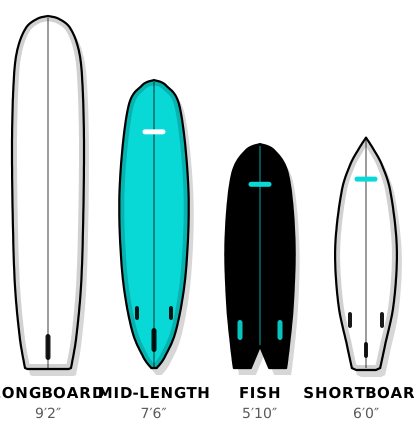
Longer boards paddle faster, catch waves earlier and are steadier front to back. Shorter boards turn tighter and fit in steeper waves. Your height matters a little for stance and comfort, but the type of board matters far more. A 6'2" fish and a 6'2" shortboard are completely different boards.
Width, thickness and outline
Wide, full outline: more stable, gets going easily in weak waves. Narrower outline: fits steeper waves and goes rail to rail more easily.
Wide tail: lift and speed in slow waves. Pulled-in tail: control and hold in powerful waves.
Thick, full rails float more and forgive more. Thin rails bite harder but ask for better technique.
Rocker
Rocker is the curve from nose to tail. Low rocker glides and paddles fast, great for small weak waves, but can nosedive on steep take-offs. More rocker fits steep, hollow waves and tight turns, but feels slow in weak surf.
Tail shapes
A tail is never picked on its own. It works with the outline, rocker and fins. Diamond and other specialty tails depend on the actual board, so ask us.
Fins: single, 2+1, twin, thruster, quad
Single fin: longboards and flowing, drawn-out turns. 2+1: a single plus two side bites, for longboards, mini-mals and mid-lengths. Twin: fast, loose and skatey, mostly on fish. Thruster: three fins, the go-to for all-rounders and shortboards. Quad: drive and speed down the line.
Fin size starts with your weight, then the fin brand's own chart, the template and the waves. There's no one-size chart that works for every brand.
FCS II, Futures and other fin boxes
The fins have to match the boxes in your board. FCS II and Futures fins don't swap. Older FCS (two tabs) is different again, and longboards use a US box. Soft-tops often have their own fittings. Check the board before you buy fins, or ask us.
Soft-top, PU or epoxy?
Soft-top: the best place to learn and great for family boards. Tough and kinder in a collision. Not every soft-top is a beginner board.
Soft deck, hard bottom: a step between a foamie and a fibreglass board.
PU with polyester resin: the classic feel and flex. Dings easily but is easy to repair.
EPS with epoxy resin: usually lighter and floatier for the same shape. Repair it with epoxy only, never polyester. "Epoxy" on a label can also mean PU foam with epoxy resin, which is different again.
Premium builds like Firewire's are great, but you don't need one to improve.
Stay safe out there
No board makes unsafe waves safe. Surf at patrolled beaches while you're learning and check where boards are allowed. Know how to spot a rip. If you get caught in one, stay calm, float, and raise your hand for help. Wear a leash that suits your board, watch out for others, and if in doubt, stay out. Surf Life Saving NZ has more at surflifesaving.org.nz.
Still not sure?
Come in and have a yarn. We're at 306 Hibiscus Coast Highway, Orewa, across the road from the beach. Or call us on 09 427 9552.